Female Rage is So Back
I went to a concert last week & after it I couldn’t shake the thought that female rage is so back. How do you explain that though? Every day since, I have not been able to shake that concept from my mind. I’ve been exploring it from different angles & specifically through the context of music. A good starting point is the 90’s.
I have the Jagged Little Pill album playing in the background while writing this right now.
So let’s explore this together.
When I think about female rage, I don’t think about unjustified rage misdirected at people who have done nothing wrong. To me, female rage is the rage that comes from oppression in our patriarchal society. It is something that comes after many years of letting small things go to keep the peace. It is the injustice of the pay gap. It is the misogynistic undertones woven into so much of our society... the jokes that are made, the roles that are expected, not getting an equal seat at the table. It is the assault that women experience, the abuse of power, the unrealistic expectations, the insane double standard that exists between men & everyone else.
Female rage is people using their voices in a powerful way to stand up for themselves & express their experience — all of these things that make small paper cuts into a giant gaping fucking wound. It is the act of allowing yourself to actually be angry at the ways you have been treated unfairly & speaking up about it. In a way that says “no fucking more.”
I grew up around strong women... women who weren’t afraid to speak their minds. I admired them, but I also felt a slight discomfort about it. Not because of them, but because I had learned early on how the world responds to women like that. Instead of being seen for their strength, they were labeled unpalatable, too much, crazy.
The 90’s were so prominent for this. It really felt like a time where women were able to defy societal standards & actually had a large audience for it. It also had some of the most blatant forms of misogyny in the media. I think this set the stage for what came next, because the early 2000’s were a really ugly time to be a celebrity. I am thinking about Lindsey Lohan, Paris Hilton, Britney Spears, Amanda Bynes. We will be here for a long time if I even start going down the rabbit hole of what happened to women of color & queer celebrities in the same era.
The 2000’s were the response to the 90’s... it was scary when women started using their voices & getting more power, so how did our society assert that dominance? By fucking wrecking young women & abusing power.
26 years later, I think the 90’s are back, but in a way that is probably more frightening for the patriarchy.
I want to be very clear though, that this is not an “all men are evil” piece. This is about standing up to toxic masculinity, which can live within anyone regardless of gender. Toxic masculinity is what has been driving the patriarchal society. There are plenty of people who carry healthy masculine energy & we love healthy masculine energy. Healthy masculine energy is assertive without force, it is protective, it doesn’t need to compete with or control everything to feel secure. Our society needs the balance of both masculine & feminine energies to be at equilibrium. That is what a healthy society looks like.
What made me think that female rage was “so back” after going to this concert?
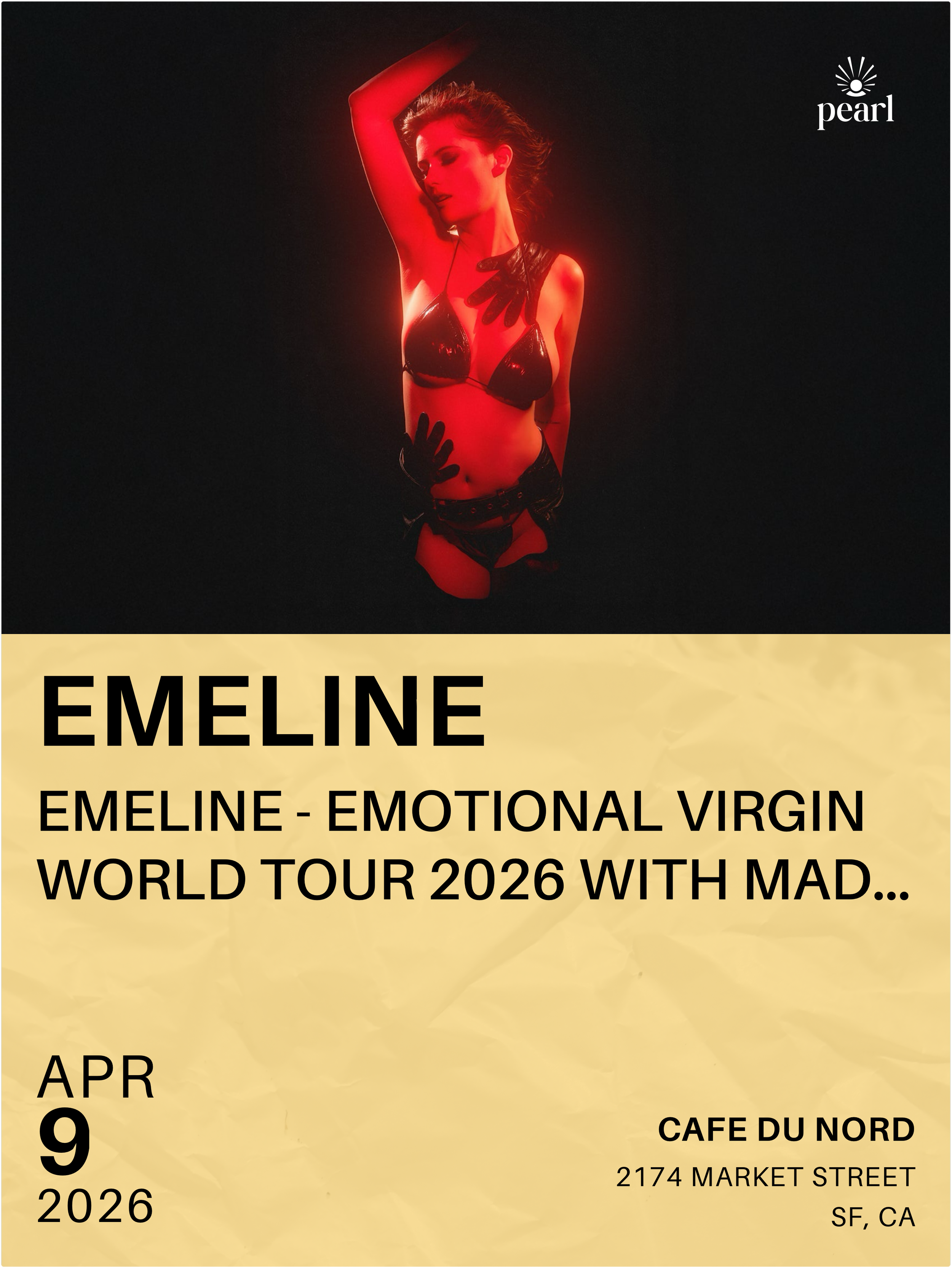
It was the conversation & music being performed there. The concert was for an artist, EMELINE, & she had an opener, DEZI. DEZI was maybe 5’2 but she commanded that stage & had so much energy. She talked about the state of the world & our president. She told her story through her music. She literally performed her song called rage.
Then EMELINE came on & the entire arc of her performance was about taking her power back after experiencing assault & owning her female body & experience as a performer. She even directed it back to how our current president is one of the biggest offenders of abusing power & he literally holds our country in his hands.
At the same time, I had been reading Melissa Auf Der Maur’s new memoir. Melissa was the bass player in Hole & later in Smashing Pumpkins, so she had a front row seat to the entire era of 90’s music. She joined Hole right after Kurt Cobain’s death & the previous bass player had also just died from an overdose, so she got to see everything with very clear eyes... she was not on hard drugs & she remembered the 90’s in a way that a lot of people from that era simply couldn’t.
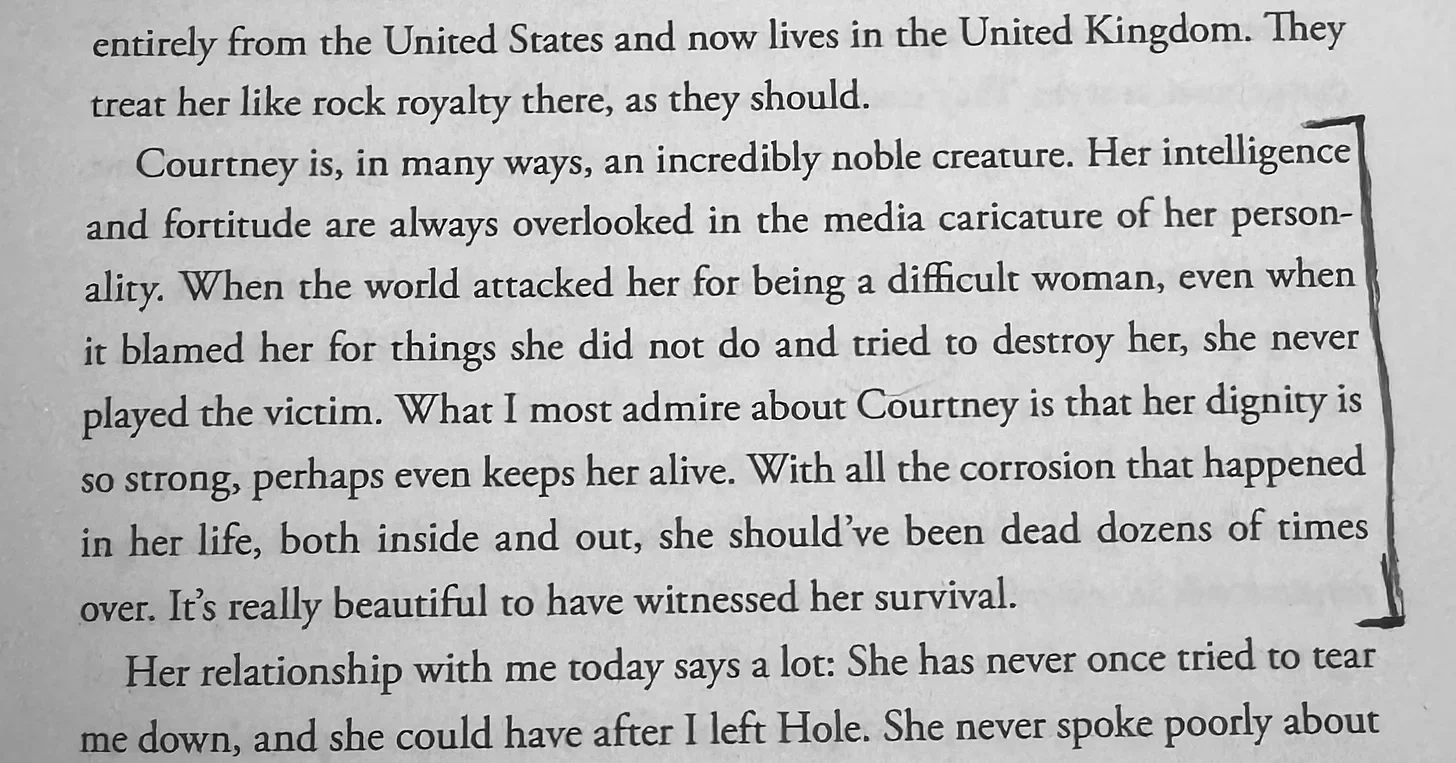
Excerpt from Melissa Auf der Maur’s memoir: Even the Good Girls Will Cry
She wrote about Courtney Love eloquently & with a lot of care… holding Courtney’s complexity. Courtney is a prime example of a woman who has been completely shredded by the media & our society over the years. She also represented the epitome of female rage in the 90’s, with her screams on stage & her refusal to be palatable. She is a complex human being who was dealt a really tough hand in this lifetime. Before this last year, what I knew of Courtney Love was that she was Kurt Cobain’s wife, that she had a severe drug problem, & all of the talk about her & Kurt doing heroin while she was pregnant with their daughter Frances. That is literally all I knew. & you know what? That is exactly how the media wanted her to be portrayed.
Yes, Courtney was an addict & there was real controversy surrounding her, but so were a lot of artists in the 90’s... a lot of male artists specifically, & they were not torn apart in the same way she was. Kurt wasn’t torn apart the way she was, although he was doing all of the same things. Courtney is the one who actually had to survive all of it, for all of the years since. From Melissa’s memoir, from Billy Corgan’s recollections, from old interviews... she was wildly intelligent. She was not afraid to speak her mind or be authentic & I think that was extremely threatening to people, so she got painted as a crazy addict. An addict, yes, but certainly not crazy.
Online there is a lot of rhetoric these days that everyone owes Courtney Love an apology & that feels like a sign that maybe our world is ready to actually face the female rage & listen to it.
Courtney wasn’t the only one. Sarah McLachlan is another example. This last year I heard about Lilith Fair for the first time & watched the documentary Lilith Fair: Building a Mystery. Holy shit. Afterwards I was like... am I the only person who didn’t know about this festival Sarah put on? I asked so many friends & not a single one knew either. I had only ever known Sarah McLachlan from the SPCA commercials. That was literally the only thing I could have told you about her.
Lilith Fair got slammed in the media, but it did so much for women in music. They had to fight through so much doubt about whether an all-female festival could even work & at that time you couldn’t even play two female artists back-to-back on the radio. They were the butt of so many jokes & had to field some truly insane questions every time they did press. & then it was wildly successful. People wanted to hear their music & their voices & that proved something important.
Then we get to the 2000’s, where all of that forward progress apparently got too threatening.
The Chicks got cancelled for speaking up about President Bush & being against the war. Another group of women who were bold with their voices, & the media portrayed them as angry & crazy. It was the same pattern over & over again... women are crazy or unjustified when they speak up. Erasure or humiliation was the solution to women saying too much or getting too powerful.
The sad part is that my generation didn’t grow up knowing these stories. I grew up in a household full of this music from the 90’s, it was playing around the house constantly & it began shaping my taste, but I didn’t know the full picture of who these women were or what they were up against. That history got buried right along with them.
Things are certainly different now than they were then. There has been a significant amount of progress, but we aren’t fully there yet. At this point, with social platforms & the widespread distrust in media, the media physically can’t run the same playbook they did in the past.
Chappell Roan is a great example of this. This past month, a soccer player accused her of having her security guard go & harass his daughter. This caused weeks of her getting shit for it... even after she spoke out about not knowing about this & the security guard backed her up that he acted on his own accord. She still had to deal with all of the immediate backlash though & it was insane. If this happened in the 90’s or 2000’s, I am not sure her truth would have ever seen the light of day. This last week, the soccer player issued a statement saying that he got the situation wrong with Chappell Roan, although he still didn’t actually say ‘sorry’ in the statement. This should have never gotten as far as it did & she should not have to endure bullshit like that, but I am glad that the truth came out... & it didn’t take years to do so.
Chappell is one of those artists that is bold & unapologetic, both within her music & in how she moves through the industry, so it threatens people & she is constantly having to field that.
This is what I’ve been exploring & I am not at a clear conclusion here because we still aren’t fully there. There is still misogyny & we are still operating in systems that really benefit the patriarchy & extreme capitalism. BUT I know that female rage does make a difference. It gives a voice to a lot of people with similar experiences.
Maybe that’s why I couldn’t shake it. In the room at that concert, there was such a sense of hope & understanding & authenticity & femininity all in one. It is the type of anger that doesn’t feel misdirected or like lashing out. It’s that kind of anger where it’s like “Yeah I deserve to be upset about this because I deserved better.”
A few songs I think perfectly embody this concept:
